Translate

Showing posts with label Truth. Show all posts

Friday, August 2, 2013

Scientism: A Willing Ignorance

In 1884, Edwin A. Abbott wrote Flatland: A Romance of Many Dimensions. The book is set in a world inhabited by two-dimensional shapes that play roles within this two dimensional world. The shapes see and experience life in one dimension, much how we as 3D persons see the world as a two dimensions. The inhabitants of this world flatly deny (pun intended) that there can be a world that has more than two dimensions because, in their experience, they have never seen a 3D object, and nor can they because of their limited ability to see or measure. Therefore, they reject the idea that anything beyond flatland exists.

This is the case until a sphere passes through Flatland. The 2D shapes cannot take this sphere in fully, in fact they can only see him as different sizes circles as he literally passes through Flatland, transcending the binds of the two dimensions and experiencing his third. Not only that, but to further prove himself, the sphere takes a square up and out of flatland in order to give him a birds-eye view, and forever changing the square's outlook on reality. For a clearer summary, click here.

I want to take a moment to look at this book as a commentary on the phenomena of scientism that is rampant within our culture. Scientism is the philosophical, not scientific (more on that later), idea that, if something cannot be measured or observed by science, it cannot exist. This idea is subscribed to by everyone from leading atheists to your run-of-the-mill cultural devotee with a bone to pick against organized religion. Scientism-based thought generally come at the head of the atheistic apologetic, and is presented as being at odds with any notion of faith.

However, scientism is a philosophy that does not hold up under any kind of scrutiny. First of all, scientism is not scientific. The basis of science is to investigate and uncover that which has NOT been discovered. To say that all that exists is only what can be measured scientifically is to state one of two things. Either (a) you are basing life on the assumption that we currently fully understand and can measure all forces of nature and movements within the word, or (b) you are open to the idea that reality literally shifts every time a new discovery or theory is made. Under the former assumption, theoretical scientists simply become nerds with an imagination, and under the latter assumption, you are looking at reality itself as something that is inherently unstable, awaiting the next observation to further shift 'truth' into something else.

The second problem with scientism is that fact that it is a self-defeating proposition. To one that would say to me "all that is real is measurable and observable", I would respond by asking, "is that idea measurable and observable?" By that I mean, can you scientifically prove to me that all forces in the world are measurable and observable? Can you prove the content of that statement through the scientific method (developed by a catholic) and prove you hypothesis correct? The answer is an unadulterated "No Freaking Way!" To believe so is to contradict yourself, your purpose, and proves to me that you're simply a Dawkins fanboy with too much time to kill.

If this is you, you are terrible...
Finally, scientism does not leave room for the idea that there is something beyond our experience. Much like the inhabitants of Flatland, subscribers to scientism assume that our experience is the pinnacle of what can be known, and that our instruments for measurement are capable of measuring all that is. But if we cannot scientifically and empirically prove beyond any doubt that the basis of scientism is true, then room must be left for faith in something beyond what our 3D perspective can behold.

Honestly, I think the rejection of faith comes from our western fear of losing control. If we can measure every part of reality, we can then control and monitor every part of reality. However, if reality goes beyond what we can know with our senses, and if there is something that inhabits a world beyond our simple three dimensions, passing through yet transcending the reality we can know by observation, then it must be (a) more powerful than us, (b) beyond our control, and (c) know us better than we can know ourselves, just as we know the ins and outs of a character we draw or a shape we see.

We must allow ourselves, like the square in the story, to be lifted above what we know in order to see reality as it is, and to take in the idea that there is something more. The square did not experience the full length, width, and height of the three dimensional world, but he knew it was there. He could apply that knowledge back into his more limited reality and allow it to help shape him (more puns!). my encouragement is to ask yourself the question, "what if there are things we cannot measure?", and allow faith in something beyond the arrogant western view of self. Only then can we begin to grasp true reality.

St. Joseph, pray for us
God, Father in heaven, bless us.
Thursday, June 20, 2013

Tragic Misappropriation

I think we all want to think of ourselves as smart, don't we? It's not that we just want to hold a conversation or gain the admiration of other people. While all of that is nice, and even useful or pleasant, humanity seeks knowledge in an effort to grasp that which is bigger than ourselves. We seek to wrap our minds around complex realities that fascinate and amaze us, not simply because we want to amuse or educate ourselves, but because central to our personhood is an orientation to the greater, more transcendent, elements of life which go beyond our simple senses and lead us to the conclusion that we cannot be made for a limited time or space.

The very fact that we can see and conceptualize something beyond what we see and feel separates us from the rest of the created world. No matter how smart your dog may be, or how many signs you teach Koko the gorilla, they will never be able have faith or hope in anything because they have no sense of it. They are merely mortal creation, bound to the limits of their sensory world.

Sad right? NO! This is order! This is natural hierarchy! This is the nature of all creation pointing to us and past us as we stand on the pinnacle of what can be held, and look beyond us to a world that can only be known by revelation and meditation. It can be pondered and expounded upon, and our knowledge of it can be transposed by those gifted by God with the depth of intellect needed to pare such transcendent realities into something that can be understood and studied.

It is with these minds pondering all manner of science and philosophy that we come to understand who we are and how we were made, both physically and spiritually, and we gain an understanding of how we are to relate to one another and how we are to relate to that singular infinite greatness that stands above us and reaches out to us. This is how we come to study philosophy, theology, sociology, history, biology, and all other manner of sciences that are meant to pull our experiential and spiritual knowledge together and bring us into greater awe and devotion to the one who made it all.

However, what happens when God is ignored? What happens when the gift of intellect is given yet misdirected. What happens when the hierarchy of nature is disregarded, or worse, what if those gifted and eloquent minds take the pointing of nature to indicate finality and climax in the human person, and a philosophical glass ceiling is placed on the investigation of who we are?

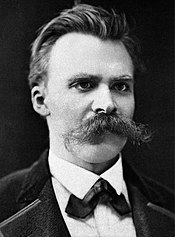
Neichze: Thinking as crazy as his mustache
In a western world where we do not want for anything material, and are slowly ridding ourselves of any true connection or relationship of self-giving love, we are leaving our minds and hearts open and able to hit the limits of sensual experience and turn back inward upon ourselves. All of a sudden, the wants and desires of our hearts and minds, the only things that remain even partially transcendent, become gods of our making that demand worship.

All of a sudden, those minds who were gifted to grasp and verbalize the transcendent mysteries are given the place of priest and prophet within the secular religion, and they are tasked to look at the disorder of life and explain it away. Whether we are talking of sexual immorality, loss of identity, or simply the habitual sin experienced and perpetrated by countless souls on a daily basis, the task of the thinker is to make it okay.

So, as a result, we have theories and philosophies that could fill thousands of volumes. However, all lead to the same end: Everything is moral, and every new depravity can be chalked up to social phenomena or societal evolution. All this because the God and Father if all, who made all thing to point beyond humanity to a place that fulfills all desire, is removed, and all that was made to point to eternity become an ends in themselves. Philosophical and social scientific thought is done for its own sake, leaving us with a culture that continually practices a form of intellectual masturbation.


And who are the casualties of such a system? Simply put, the students. Those disciples of the secular prophets who are subject day after day to the thought of other lost souls cannot help but to drown in what they are served. The result are artists and thinkers who spit out the same misguided ideas of humanity and our "purpose" under the guise of free thought and enlightenment. All the while, they dig deeper and deeper inward upon their own hearts and minds, trying to find meaning that remains behind them, beyond that glass ceiling and into eternity.

At the end of the day, we cannot look at our world without first understanding and realizing that there is a loving Creator who built all things in order to bring us closer to him. He is not doing so to achieve some sort of vain glory. On the contrary, he has laid the path before us to walk into eternity. He has come down, incarnate, to bridge the gaps and set us free from the ropes of relativism and sin that bind us to our senses. We must take a step beyond what we see and know, and allow ourselves to be caught up into a person that is ever ancient, yet ever new.

Saint Joseph, pray for us
Father, God in heaven, bless us

Monday, March 4, 2013

Morality is for Real... Suck it Up


Look, I've already reconciled with the fact that, when it comes to my sociology classes, I am The Enemy. I am a Catholic, conservative, middle class, white, straight, male. According to my classes and classmates, this means that all "inequality" that has been "suffered" by women, minorities, the poor, and those with same-sex attractions throughout the centuries is not only caused, but is maintained by me and my ilk.

How do we evil men do it? We apply gender roles and arbitrary morals on people throughout their lives in order to keep everyone stuck in mud along with us. We obviously refuse to think or to "open our minds". It goes without saying that we hate everyone who disagrees with us. "Why can't we all just get along?", you ask, and we simply respond by punching people in the face and imposing our morality on the poor, oppressed masses.
If you think this is who I am or what the Catholic Church is, I ask you gently turn off your computer and slam your head forcefully and repeatedly into the nearest wall for all the good you bring to this discussion. I'm only going to say this once: The norms that we have and the morals that have been passed down by the Church through the millennia are not an imposition or an effort to keep everyone else from having fun or "being who they are" (hippies). They are objective reality and truth that has been tested and refined over the course of HUNDREDS of years by some of the most intelligent and enlightened men ever to grace this planet. Simply because you don't like it doesn't mean it's wrong. Simply because it calls you to change does not mean its an imposition.

Stacks upon stacks of wisdom


Right and wrong are concrete objective states. Just because it challenges you doesn't mean you have ability to define you own morality. The second you start to say that what's right "for you" is different than what's right "for me" you should return to slamming your head into that good ol' wall. You see, the danger in trying to define your own morality is that you make yourself the author of right and wrong. What arrogance! What self-aggrandizement! The danger in saying "why can't we just let everyone do their own thing" means that you're still limiting those who disagree with you.

For instance, in the debate over same-sex marriages, people keep coming back to the idea that everyone should just allow everyone to do what makes them happy. Everyone should just be allowed to marry whoever they want and practice marriage however they want. Well, say that your right and marriage is allowed to be redefined. All of a sudden, the largest organization of people in the world, the Catholic Church, is forced to betray their morals. Why can't they be allowed to practice and defend what they believe? Is it because you simply don't like it?

Relative thinking in terms of morality always falls apart because it doesn't work in reality  One morality always needs to be placed above the others. To fall into a groove of right and wrong, whether you define your own or not, means that someone else is indeed WRONG. So the question becomes, what makes your morality (or lack thereof) so much better than mine? Your degree? The Catholic Church is and always has been the center of thought and education the world over. Is it your life experience? The Church has existed for 2000+ years and has experienced all manner of life over that course of time. Is it your novelty of insight? Well why would novelty in morality be appealing to being with? In the chaotic nature of the world we live in, why would I want to follow an unproven system of morality? The Church understands the human person, and the morals and doctrines that are passed down come from the fundamental knowledge of the wants and needs of the human person.

Here's a new thought, your "enlightened" thinking has bound you. You are a slave to the shifting trends and fashions of thought that go by the wayside when a new philosophy presents itself. History is full of examples. The sexual revolution and the rise of contraception, which was supposed to free women, has resulted in a 50% divorce rate, higher rates of domestic violence, and the abortion of 1/4 children who are conceived. Is that freedom? The enlightenment of the 18th century was supposed to result in peace and equality for all, but it resulted in the French Revolution and the widespread use of the guillotine. The spread of communism was supposed to put everyone on equal footing and ensure the happiness of all citizens. In the Soviet Union alone, it resulted in the death of millions of innocent people.

The morals that the Church puts forward are concrete and are proven. They are not a list of legalistic rules that need to be followed for their own sake. They are invitations to freedom! Think of it like this. Your life is a high plateau with a sheer 200 ft drop on all sides. The doctrines of the Church are the fence that keep you safe and free. You can do anything you want within the fence. You're also free t jump the fence, but this comes with the unfortunate consequence of a 200 ft fall to your death. You are not limited by the fence. It doesn't ruin your happiness. On the contrary, this absolute and concrete set of posts and pickets keeps you alive and allows you to experience life to its fullest.

Cartoons teach us so much!
Every "thou shalt not" comes with a "thou shall". Every "you cannot" comes with a "you can". The Church, in her infinite and proven wisdom is inviting all of us to truly live life to the full. We cannot do that with a relative idea of what is right and wrong. If nothing is wrong, then nothing is right. The rules come not from hate but from a loving understanding of who we are as human beings. Nobody faults a parent for the rules that they lay out for their children. They simply know their children and what they need. The Church is the same way. Let go of your pride! Accept that you don't know everything and allow yourself to learn! Stop trying to make the world in your own image. It is only when we let go that we can truly begin to make sense of things. So yes, morality is concrete, objective, and real. Suck it up and enjoy your life for once!

Joseph, model of manliness, pray for us
God, Father in heaven, bless us.
Saturday, January 19, 2013

The Search for Truth: A Self-Titled Post

I don't think it matters whether you are religious or not. The scene in John's gospel where Pilate interrogates our Lord is a chilling passage. Pilate, the Roman governor of what was considered to be a troublesome province has a beaten and bruised carpenter brought before him. This apparent rabbi is accused of blasphemy and, on the eve of the Sabbath, the Jewish leadership is calling for his execution. Not being one to easily fold to hysteria, Pilate calls this Jesus in for questioning. After a roundabout line of interrogation, Jesus finally says to Pilate, "You say I am a king- for this I was born and for this I came into the world, to testify to the truth. Everyone who belongs to the truth listens to my voice.", to which Pilate responds, "What is truth?" (John 18:28-38)

Pilate asks, "What is truth?"
Pilate's final question is one that rings with me personally, and in my opinion, it stands as one the great questions of our age. Now, if you have been active in Catholic circles for more than five minutes, you have most likely been told about the relativistic culture of western society and the need for the acknowledgement of objective truths in order define our morality, our spirituality, and our very place in the world. This is true and I could write all about it, but men much smarter than I have taken up the task and it would be presumptuous of me to try and say something that has most likely been pondered and written about my many a scholar.

What I want to write about instead is something under the surface of the debate as to whether or not objective truth exists. I want to discuss why we even care. Why does it matter whether something is true or not? Why, if something is true, do you even have to share it? Finally, if there is truth in this world, how do we find it?

But first, a little background. I am a senior sociology student a George Mason University. I have spent the majority of my undergraduate career studying the various ways in which people socialize, and how those social worlds shape us and our relationships with one another and with society. I can confidently say after 4+ years in college that sociology is a largely liberal science that, in my opinion, tries all too often to fit the world into preconceived theories and worldviews developed by people who are far too interested in their own opinions to really care as to whether or not their theories truly fit. Now, I say this for two reasons. On the one hand, I've just wanted to say that about sociology forever. On the other hand, despite the flaws of its practitioners, I still have faith in sociology as a science, not because of what it has done or achieved, but because of what it seeks. As with any other science, whether it be natural or social, sociology asks the same question that Pilate asked of Jesus: "What is truth?"

You see, human beings are not simply passive creatures. We search for things. We search for love, happiness, companionship, community, fulfillment, and all other manner of seemingly abstract things. But, at the heart of every person and every question lies the desire to know oneself and to know the world one lives in. This is what we commonly call the search for the truth. We want to know fully, and we do not accept answers that we consider to be lies or half-truths. Somehow, we all know that there is a right way to live, and an answer to the question of who we are and how we relate to this world (hey look! I just disproved relativism!). So we reach out. We try to find the answers. We develop systems that lead us to truth and help us to know the answers to our deep and fundamental questions.

This is where all of our various scientific and religious endeavors enter the picture. And yes, I do truly mean both. As the late John Paul II said in his encyclical letter Fides et Ratio, "Faith and reason are like two wings on which the human spirit rises to the contemplation of truth". And he's right! Think about it. We have all met  people who are on either side of the spectrum. In one corner, we have the person who relies only on faith while rejecting social and scientific proofs to the detriment of his own knowledge, and in the other corner we have the staunch atheistic whack-job who relies only on quantifiable data with no belief that there could possibly be anything more that what it laid before him. Both are angry and defensive, and the irony is that the more one drifts to one end or the the other, the more he thinks that he is rational while everyone else is crazy.

So where does this dualistic notion of investigation leave us? It leaves us stranded between two camps, feeling as if we need to choose between faith or science to answer our deep and burning questions. Well here's a lifeline my dear friend. You don't need to choose!


Gregor Mendel: Father of Genetics
The Church has always said that as long as we are seeking truth, we are seeking God. In fact, that's why the Catholic Church has been the largest patron of education in all of human history, and why many of the most famous and influential scientists have been faithful Catholics. That's right, as Gregor Mendel (a monk) was developing the basic laws of genetics, he was searching the face of God. As were Roger Bacon (a friar) when he developed the scientific method, and Nicolas Claude Fabri de Peiresc (an abbot) when he discovered the Orion Nebula. They used their reason to make great leaps in science which only deepened their faith when they sought truth in prayer and in the sacraments. These were balanced men who rose to a greater knowledge of truth through the investigation of both empirical science and religious devotion. How else can one delve into things unseen and undiscovered without faith that there is something greater than what is known?

Now, many atheists will say that the Church is against science. To that I blow an enormous and audible raspberry. I challenge them to look up the lives of the men I mentioned above as well as this list for more information. The most famous objection, of course, is the fact that Galileo was forced to recant his findings by the Church. They will also mention that the Church never officially apologized to Galileo until 1992. To that I say, our bad for the mix up, now get over it. We had bigger and more important things to worry about than Galileo's feelings.

The point is, don't be discouraged by factions of atheists and religious alike who would tell you that you must choose between religion and science, between faith and reason. In order to truly find ourselves and answer the deep questions of our hearts we need both. We need to understand how the world works. It has the potential to increase our faith in a Creator who put so much detail in the universe to be discovered and investigated. However, we have to have an understanding that we are not the be all end all. There is a God who has put within us a desire to know truth; to know him. We can have faith in a God that reveals his own beauty and intricacy in understandable and quantifiable ways while still expanding beyond them into infinity. Hopefully with our faith and reason developed and unfolded, we can answer Pilates inquiry and point to what is really true and what is really good.

Joseph, model of manhood, pray for us
God, Father in Heaven, bless us